1893 · 6 min read
The Widow and the Judge
Selected · Touching Incidents and Remarkable Answers to Prayer, 1893
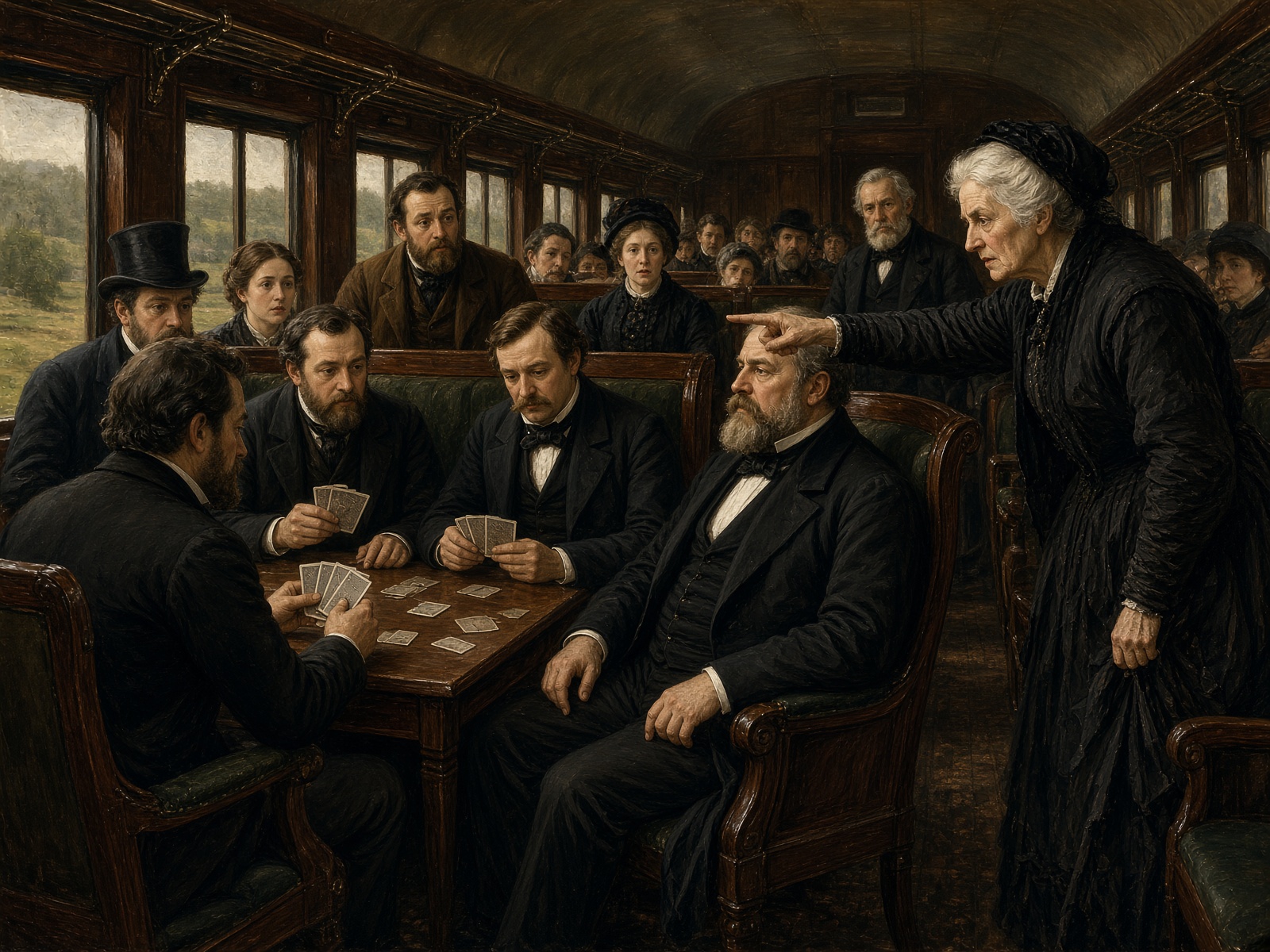
Sometime about the commencement of the year 1871, train was passing over the North-Western Railroad, between Oskaloosa and Madison. In two of the seats, facing each other, sat three lawyers engaged at cards. Their fourth player had just left the carriage, and they needed another to take his place.
"Come, Judge, take a hand," they said to a grave magistrate, who sat looking on, but whose face indicated no approval of their play. He shook his head, but after repeated urgings, finally, with a flushed countenance, took a seat with them, and the playing went on.
A venerable woman, gray and bent with years, sat and watched the Judge from her seat near the end of the railway carriage. After the game had progressed awhile, she arose, and with trembling hand and almost overcome with emotion, approached the group.
Fixing her eyes intently on the Judge, she said in a tremulous voice: "Do you know me, Judge — "
"No, mother, I don't remember you," said the Judge, pleasantly.
"Where have we met?"
"My name is Smith," said she; "I was with my poor boy three days, off and on, in the court-room at Oskaloosa, when he was tried for — for — for robbing somebody, and you are the same man that sent him to prison for ten years; and he died there last June."
All faces were now absorbed, and the passengers began to gather around and stand up all over the car, to listen to and see what was going on. She did not give the Judge time to answer her, but becoming more and more excited, she went on, "He was a good boy, if you did send him to jail.
He helped us clear the farm; and when father took sick and died, he done all the work, and we were getting along right smart. He was a stidy boy until he got to card-playin' an' drinkin', and then, somehow, he didn't like to work after that, and stayed out often till mornin'; and he'd sleep so late, and I couldn't wake him when I knowed he'd been out so late the night afore.
And then the farm kinder run down, and then we lost the team; one of them got killed when he'd been to town one awful cold night.
He stayed late, and I suppose they had got cold standin' out, and got skeered and broke loose, and run most home, but run agin a fence, and a stake run into one of in; and when we found it next mornin' it was dead, and the other was standin' under the shed.
And so, after a while, he coaxed me to let him sell the farm, and buy a house and lot in the village, and he'd work at carpenter work. And so I did, as we couldn't do nothin' on the farm. But he grew worse than ever, and after awhile, he couldn't get any work, and wouldn't do anything but gamble and drink all the time.
I used to do everything I could to get him to quit and bea good, industrious boy agin; but he used to get mad after awhile, and once he struck me, and then in the morning I found he had taken what little money there was left of the farm, and had run off.
After that time I got along as well as I could, cleanin' house for folks and washin', but I didn't hear nothin' of him for four or five years; but when he got arrested and was took up to Oskaloosa for trial, he writ to me."
By this time there was not a dry eye in the car, and the cards had disappeared. The old lady herself was weeping silently, and speaking in snatches. But recovering herself, she went on, "But what could I do? I sold the house and lot to get money to hire a lawyer, and I believe he is here somewhere," looking around.
"Oh, yes, there he is, Mr. —;" pointing to lawyer — who had not taken part in the play.
"And this is the man, I am sure, who argued agin him," pointing to Mr., the district attorney.
"And you, Judge, sent him to prison for ten years; spose it was right, for the poor boy told me that he really did rob the bank; but he must have been drunk, for they had all been playin' cards most all the night, and drinkin'. But, oh dear! it seems to me kinder as though if he hadn't got to playin' cards he might a been alive yet.
But when I used to tell him it was wrong and bad to play, he used to say: Why, mother, everybody plays now. I never bet only for the candy, or the cigars, or something like that.' And when we heard that the young folks played cards down to Mr.
Culver's donation party, and that Squire Ring was goin' to get a billiard table for his young folks to play on at home, I couldn't do nothin' with him. We used to think it was awful to do that way, when I was young; but it jist seems to me as if everybody was goin' wrong now-a-days into something or other.
But may be it isn't right for me to talk to you, Judge, in this way; but it jist seemed to me the very sight of them cards would kill me, Judge; I thought if you only knew how I felt, you would not play on so; and then to think, right here before these young folks!
May be, Judge, you don't know how younger folks, especially boys, look up to such as you; and then I can't help thinking that may be if them that ought to know better than to o so, and them as are better larnt and all that, wouldn't set sich examples, my Tom would be alive and caring for his poor old mother; but now, there ain't any of my family left but me and my poor granchile, my darter's little girl, and we are going to stop with my brother in Illinoy."
Tongue of man or angel never preached a more eloquent sermon than that gray, withered old lady, trembling with old age, excitement and fear that she was doing wrong. I can't recall half she said, as she, poor, lone, beggared widow, stood before the noble looking men, and pleaded the cause of the rising generation.
The look they bore as she poured forth her sorrowful tale was indescribable. To say that they looked like criminals at the bar would be a faint description. I can imagine how they felt. The old lady tottered to her seat, and taking her little grandchild in her lap, hid her face on her neck.
The little one stroked her gray hair with one hand and said, "Don't cry, grandma; don't cry, grandma." Eyes unused to weeping were red for many a mile on that journey. And I can hardly believe that any one who witnessed that scene ever touched a card again.
It is but just to say that when the passengers came to themselves, they generously responded to the Judge, who, hat in hand, silently passed through her little audience. — Selected.
Select any passage to copy a shareable quote. Public-domain text, preserved for the next reader.